SynopsisExtended16550< DefaultBaudRate > Struct Template Reference
The Synopsis extended 16550 UART has two additional registers that are not part of a standard 16550, one of which allows for fractional multipliers. More...
#include <platform-uart.hh>
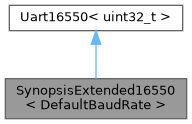
Inheritance diagram for SynopsisExtended16550< DefaultBaudRate >:
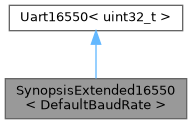
Collaboration diagram for SynopsisExtended16550< DefaultBaudRate >:
Public Member Functions | |
| void | init (unsigned baudRate=DefaultBaudRate, unsigned timerFrequency=CPU_TIMER_HZ) volatile |
| Initialise the UART. | |
| Public Member Functions inherited from Uart16550< uint32_t > | |
| bool | can_write () volatile |
| Returns true if the transmit buffer is empty. | |
| bool | can_read () volatile |
| Returns true if the receive buffer is not. | |
| uint8_t | blocking_read () volatile |
| Read one byte, blocking until a byte is available. | |
| void | blocking_write (uint8_t byte) volatile |
| Write one byte, blocking until the byte is written. | |
| void | init (int divisor=1, T &&otherSetup=no_custom_init) volatile |
| Initialise the UART. | |
Public Attributes | |
| uint32_t | loopback |
| Loopback register. | |
| uint32_t | divisorLatchFraction |
| Divisor latch fraction. | |
| Public Attributes inherited from Uart16550< uint32_t > | |
| uint32_t | data |
| The interface to the read/write FIFOs for this UART. | |
| uint32_t | intrEnable |
| Interrupt-enabled control / status. | |
| uint32_t | intrIDandFifo |
| Interrupt identification and FIFO enable/disable. | |
| uint32_t | lineControl |
| Specifies properties of the line (stop bit, parity, and so on). | |
| uint32_t | modemControl |
| Modem control. | |
| const uint32_t | LineStatus |
| The line status word. | |
| const uint32_t | ModemStatus |
| Modem status. | |
| uint32_t | scratch |
| Scratch register. | |
Static Public Attributes | |
| static constexpr uint32_t | BaudScaleFactorShift = 4 |
| The divisor is calculated from 16 times the baud rate. | |
| static constexpr uint32_t | BaudFractionBits = 4 |
| The value in divisorLatchFraction is truncated to this many bits. | |
Detailed Description
template<unsigned DefaultBaudRate = 115'200>
struct SynopsisExtended16550< DefaultBaudRate >
struct SynopsisExtended16550< DefaultBaudRate >
The Synopsis extended 16550 UART has two additional registers that are not part of a standard 16550, one of which allows for fractional multipliers.
This is always instantiated with 32-bit device registers. The default baud rate is set as a template parameter and can be overridden in init.
Definition at line 15 of file platform-uart.hh.
Member Function Documentation
◆ init()
template<unsigned DefaultBaudRate = 115'200>
|
inline |
Initialise the UART.
Definition at line 50 of file platform-uart.hh.
References BaudScaleFactorShift, Uart16550< uint32_t >::blocking_write(), divisorLatchFraction, and Uart16550< RegisterType >::init().
Member Data Documentation
◆ BaudFractionBits
template<unsigned DefaultBaudRate = 115'200>
|
staticconstexpr |
The value in divisorLatchFraction is truncated to this many bits.
Definition at line 45 of file platform-uart.hh.
◆ BaudScaleFactorShift
template<unsigned DefaultBaudRate = 115'200>
|
staticconstexpr |
The divisor is calculated from 16 times the baud rate.
The baud rate is in the range of KHz to hundreds of KHz, whereas the clock frequency is typically tens to hundreds of MHz. The divisor must fit in a 16-bit integer (written across two 8-bit device registers) and so is scaled to ensure that it fits (by a power of two, which makes it trivial to reverse the multiplication in the hardware).
Definition at line 40 of file platform-uart.hh.
Referenced by init().
◆ divisorLatchFraction
template<unsigned DefaultBaudRate = 115'200>
| uint32_t SynopsisExtended16550< DefaultBaudRate >::divisorLatchFraction |
Divisor latch fraction.
When the divisor latch is set (for writing the divisor), this is used for the fraction. RS-232 requires a 3% tolerance for the baud rate and an integer divisor over the clock frequency of the host may not get within this range. This register is used to provide a 4-bit correction that allows baud rates to stay within the required range.
Definition at line 30 of file platform-uart.hh.
Referenced by init().
◆ loopback
template<unsigned DefaultBaudRate = 115'200>
| uint32_t SynopsisExtended16550< DefaultBaudRate >::loopback |
The documentation for this struct was generated from the following file:
- sdk/include/platform/synopsis/platform-uart.hh
Generated by
 1.18.0