StandardPlic< MaxIntrID, SourceID, Priority > Class Template Reference
Driver for the standard RISC-V Platform-Local Interrupt Controller (PLIC). More...
#include <platform-plic.hh>
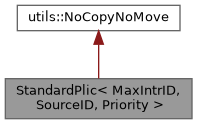
Inheritance diagram for StandardPlic< MaxIntrID, SourceID, Priority >:
Collaboration diagram for StandardPlic< MaxIntrID, SourceID, Priority >:
Public Member Functions | |
| StandardPlic () | |
| Constructor. | |
| void | interrupt_enable (SourceID src) |
| Enable the specified interrupt. | |
| void | interrupt_disable (SourceID src) |
| Disable the specified interrupt. | |
| void | priority_set (SourceID src, Priority prio) |
| Set the priority of the specified interrupt. | |
| std::optional< SourceID > | interrupt_claim () |
| Fetch the interrupt number that fired and prevent it from firing. | |
| void | interrupt_complete (SourceID src) |
| Tell the interrupt controller we've handled a specified interrupt ID. | |
Detailed Description
template<size_t MaxIntrID, typename SourceID, typename Priority>
class StandardPlic< MaxIntrID, SourceID, Priority >
class StandardPlic< MaxIntrID, SourceID, Priority >
Driver for the standard RISC-V Platform-Local Interrupt Controller (PLIC).
MaxIntrID is the largest interrupt number that is used. SourceID and Priority are the types used for interrupt source numbers and priorities, respectively.
Definition at line 19 of file platform-plic.hh.
Constructor & Destructor Documentation
◆ StandardPlic()
template<size_t MaxIntrID, typename SourceID, typename Priority>
|
inline |
Constructor.
Initialises the interrupt controller with all interrupts disabled.
Definition at line 26 of file platform-plic.hh.
References CHERI::Capability< T, IsSealedT >::address(), CHERI::Capability< T, IsSealedT >::bounds(), and MMIO_CAPABILITY.
Member Function Documentation
◆ interrupt_claim()
template<size_t MaxIntrID, typename SourceID, typename Priority>
|
inline |
Fetch the interrupt number that fired and prevent it from firing.
If two or more interrupts have fired then this will return the highest-priority one.
If no interrupt has fired (for example, because the interrupt line on the core was raised spuriously) then this returns stdd:nullopt.
Definition at line 98 of file platform-plic.hh.
◆ interrupt_complete()
template<size_t MaxIntrID, typename SourceID, typename Priority>
|
inline |
Tell the interrupt controller we've handled a specified interrupt ID.
Definition at line 108 of file platform-plic.hh.
◆ interrupt_disable()
template<size_t MaxIntrID, typename SourceID, typename Priority>
|
inline |
Disable the specified interrupt.
Definition at line 73 of file platform-plic.hh.
◆ interrupt_enable()
template<size_t MaxIntrID, typename SourceID, typename Priority>
|
inline |
Enable the specified interrupt.
Definition at line 61 of file platform-plic.hh.
◆ priority_set()
template<size_t MaxIntrID, typename SourceID, typename Priority>
|
inline |
Set the priority of the specified interrupt.
Definition at line 85 of file platform-plic.hh.
The documentation for this class was generated from the following file:
- sdk/include/platform/generic-riscv/platform-plic.hh
Generated by
 1.18.0